“Vinyl helped us spot a twenty four thousand pound sales opportunity from one meeting that somebody in his team completely missed.”
Trent McLaren, co-founder of Vinyl, argues that the advisory opportunities most firms chase are already sitting inside the conversations they have every week — they just aren’t being captured or acted on. He reframes client meetings as simultaneously market research, product development and sales calls, and lays out the five advisory signals hiding in nearly every conversation: client goals, pain points, deferred decisions, upsell signals and emotional cues. The catch is that these signals live in how clients speak, so a word-for-word transcript matters far more than hand-written notes.
The core of the session is a live demonstration. Using a Claude skill (“advisory toolkit”), Trent mines an AI-generated sample transcript to surface signals, then feeds in several more meetings to expose cross-meeting patterns, and finally ranks the findings into a prioritised advisory opportunity scorecard scored on client need, deliverability and revenue potential. He flags a key security caveat: any LLM used with real client data must be on a plan that lets you opt out of model training.
He then shows the same workflow inside Vinyl’s “revenue opportunities” feature, which produces a one-click PDF of opportunities — complete with supporting client quotes, why each matters, and how to raise it — from a single meeting or across many at once. A recurring theme is scale: capturing hundreds of transcripts builds a firm-wide intelligence layer for spotting trends, FAQs and client sentiment.
The takeaway is a mindset shift from reactive to proactive advisory. Rather than waiting for clients to ask for help they don’t know exists, firms should keep having the same conversations, systematically mine them, and return with a specific, evidence-backed set of services. A real customer example — a £24,000 opportunity surfaced from a single meeting a team member had missed — anchors the case.
Key lessons
- Every client meeting already contains five advisory signals: goals, pain points, deferred decisions, upsell signals and emotional cues.
- You can't mine what you don't capture — a word-for-word transcript preserves how clients say things, not just a summary.
- Single transcripts are conversations, but hundreds of transcripts become a firm-wide intelligence layer for spotting trends and patterns.
- A four-stage workflow (surface signals, find cross-meeting patterns, package into priced services, draft outreach) converts conversations into revenue.
- When using LLMs with client data, opt out of model training (Teams plan or above) before pasting in any real transcripts.
- Shift from reactive to proactive: bring clients a specific, evidence-backed set of services drawn from what they already told you.
Tools mentioned
- 07:30 “Vinyl helped us spot a twenty four thousand pound sales opportunity from one meeting that somebody in his team completely missed.”
- 07:30 “Meetings aren't just meetings.”
- 12:48 “You can't mine what you don't capture.”
- 35:17 “A lot of clients won't ask for help because they don't know what to ask for.”
 , the AI meeting assistant for
accountants.
, the AI meeting assistant for
accountants. Trent McLaren — Co-founder, Vinyl
02:58A new way to look at the conversations you’re already having
The session we’re about to dive into is about how AI can turn meeting transcripts into a growth engine for your firm. How do we use AI to stop missing advisory opportunities and actually identify them in the conversations you’re already having with your clients?
A bit about me if we haven’t met before. I’m the co-founder of Vinyl, an AI meeting assistant for accounting and bookkeeping firms. I also run an agency called Journey, a go-to-market and growth marketing agency that works exclusively within the accounting tech ecosystem. I also wear the hat of head of content at the Digital Accountancy Show, so I’m juggling a few balls. I’ve spent the best part of the last twelve years working with accounting and bookkeeping firms and in accounting technology, so it’s a landscape I thoroughly enjoy. I feel like I’ve got a pretty good view of what’s happening, especially with everything that’s changing right now in terms of AI and accounting.
There are a couple of things I want to run through. The first is a new way to look at the conversations you’re already having, because what I’m going to share today requires you to do nothing different other than to continue having conversations with your clients. There are no new processes, no new things to learn. It’s just a case of having the same conversations you’re already having. I’m going to share some very practical, actionable frameworks that you can then use to extract more from those conversations.
04:27The problem: we capture conversations but never act on them
The second point is the five advisory signals that are hiding in every single client meeting. Within the meetings you’re already having, there are signals in the things clients say that often go missed. The third thing is a four-stage framework to turn those signals into sellable services. And if you stick around to the very end, I’ll give you a free toolkit. In that toolkit is a Claude skill, so if we’ve got any Claude users here, I’ve created a skill you can install in your own Claude workspace to do some of the things I’m sharing today. There’s also a nine-prompt template pack, complete with prompts you can copy and paste into whichever LLM you want, as well as a full written guide that works you through all the stages.
I want to start with the problem. Most firms are already having advisory conversations. In fact, most firms are already having conversations full stop — it doesn’t even need to be an “advisory” conversation, because how we define that word varies depending on who you speak to. The point is that in some cases we’re not even capturing the conversations, but in most cases we’re not reviewing them and we’re not acting on the potential signals within them.
Think about conversations where a client briefly mentions a cash flow concern, or that their in-house bookkeeper isn’t performing well and they’re thinking about moving them on, or that they want to hire somebody. These are all signals. These are all things they’re telling you about their business that can be turned into additional service opportunities. Missing these opportunities doesn’t make you a bad adviser, because they’re very easy to miss — they just get said in passing. We miss them because, number one, we don’t have a system to capture them, and number two, we don’t have a system to surface the insights and signals from them.
07:30Meetings aren’t just meetings
Every single conversation you have with a client contains different things. It contains market research, which tells you what’s actually going on in their business. It contains product development, giving you an idea of the services your firm could build or offer based on what clients are saying and asking for. Meetings can also be sales calls — they help you understand where the next engagement might be within your existing client base.
The reality is most people are just treating meetings as meetings. They have the conversation, send the follow-up email, brief their team on what to do next, and then move on to the next client and the next meeting. What I want to share is how we pause for a second and look at meetings differently — treating client conversations as more than just meetings, and as signals and opportunities for more that we can do to help them.
Literally last week, while I was building this presentation, I received a message on LinkedIn from a Vinyl customer telling me that Vinyl helped them spot a £24,000 sales opportunity from one meeting that somebody on his team completely missed. His team members run meetings with clients, but they may not be as commercially aware as the founder. He reviews some of those transcripts to identify additional sales opportunities, and in one meeting he found a £24,000 opportunity. What happened was the client had mentioned that somebody had left the business. He probed on who left, why, and what service opportunities could come from that. They looked in the Xero account to see what that person was being paid, and they’ve gone back to the client to offer a service to help alleviate that pressure. None of that would have been possible if they hadn’t, number one, captured the meeting, and number two, prompted the meeting. This is a real case study that landed in my LinkedIn inbox the night before this session — and it doesn’t have to be Vinyl. What I’m sharing can be done with transcripts in something like Claude or ChatGPT. You do need an AI meeting assistant to capture the transcripts, but you can use the prompts anywhere.
09:47The five advisory signals hiding in every meeting
Within each of your meetings there are a number of signals that, if we capture and analyse the conversation, start to help us understand what else we can do for our clients.
The first is client goals. Where do they want to take the business? What are they trying to achieve, both personally and in the business? The second is pain points — the frustrations costing them time and money today. The third is deferred decisions: times when they say things like “I’ll think about that” or “I’m not quite sure yet.” It gives you a sense they’re thinking about doing something but haven’t figured out how to take action. The fourth is upsell signals, where they need something beyond the scope of the current engagement. And the fifth is emotional cues — talking about feeling stressed, being excited about a huge opportunity, feeling confused, or looking for relief around a specific pain point.
Here’s what these sound like in conversation. A goal might be “we’re hoping to open a second site next year” — maybe a café with one premises wanting a second. A pain point might be “I’ve got no idea what my cash flow looks like 60 days out” — they’re flying blind, unsure how much money they’ll have in the bank, which creates uncertainty about paying bills. A deferred decision might be “we’ve been thinking about hiring a finance person for a while now,” signalling they’re looking for help they’re not currently getting. An upsell might be “we’re terrible at planning, we just react to things,” which could be an opportunity to sell more proactive financial planning. And an emotional cue would be something like “honestly, payroll just stresses me out every single month” — then it’s about digging into what’s causing that stress and whether you can take it off their hands.
12:48Why these signals get missed — and why a transcript matters
We see this all the time with customers using Vinyl. So much of this gets said but gets missed, because it’s almost like a passing comment. Somebody just says it in passing, and because you’re focused on something else, it’s very difficult to pick up in that moment.
Think about the different types of meetings you have and the signals that come up in each. In quarterly business reviews, clients are likely to talk about goals or additional things they need. In a monthly cash flow service, you might uncover pain points or emotional cues because of the stress around managing cash. In a year-end planning session, you’re looking at goals or deferred decisions. And in ad hoc check-ins, pain points and emotional cues just come up in general chitchat. Most of the time this happens naturally — you’ll be talking about their business, their family, things going on, and they start to share what they’re struggling with, because most business owners have a trusting, open relationship with their accountant and feel comfortable being vulnerable.
Everything I’ve shared is already happening in the conversations you’re having. You don’t need to ask different questions or change the frequency. But you do need to consider: are you capturing those conversations? This only works if you get a transcript. The reason a transcript is so valuable is that if I’m trying to write down what someone says, not only can I not capture it word for word, it means I’m not listening 100%, which makes me much more likely to miss the subtle points. Taking notes summarises what was said; a transcript preserves it exactly as it was — word for word. And signals aren’t just about what clients say, but how they say it: the exact words they used to describe a pain or a goal, their tone, their hesitation. Part of what I’ll show you shortly is how we mine the transcript to pull out those insights — and you can’t mine what you don’t capture.
16:55Start now: capture, then mine across many transcripts
The bar to getting started is literally this: keep having the conversations you’re already having, and record them. The best time to start using an AI notetaker was twelve months ago; the second best time is today. It doesn’t need to be Vinyl — go and do your own evaluation to figure out which tool makes the most sense. But I’d urge every one of you to start using an AI notetaker, not just because it saves a huge amount of time on notes, but because of the additional things you can do once you start capturing all those transcripts.
Now think about the value beyond a single transcript. One transcript equals one conversation. When you have fifty transcripts from fifty different client conversations, that’s when you can start to spot trends and patterns — the questions clients ask time and time again. Extrapolate to several hundred transcripts and you start to build an intelligence layer across the firm: a database of your relationships with clients. All the goals they’ve shared, all the pains, all the wins, everything going on in their business, every question, every concern. This is incredibly valuable, and right now nobody’s really doing anything with it because it’s not captured in a structured way and nobody knows how to interrogate it. Keep that thought through this session — toward the end I’ll share how you can start doing this across lots of meetings in a platform like Vinyl.
19:14Demo: mining a single transcript in Claude
Let me get into the practical part. These are artificial, AI-generated transcripts — we don’t want to use real client transcripts for obvious reasons — created to simulate a typical conversation between an accountant and a client.
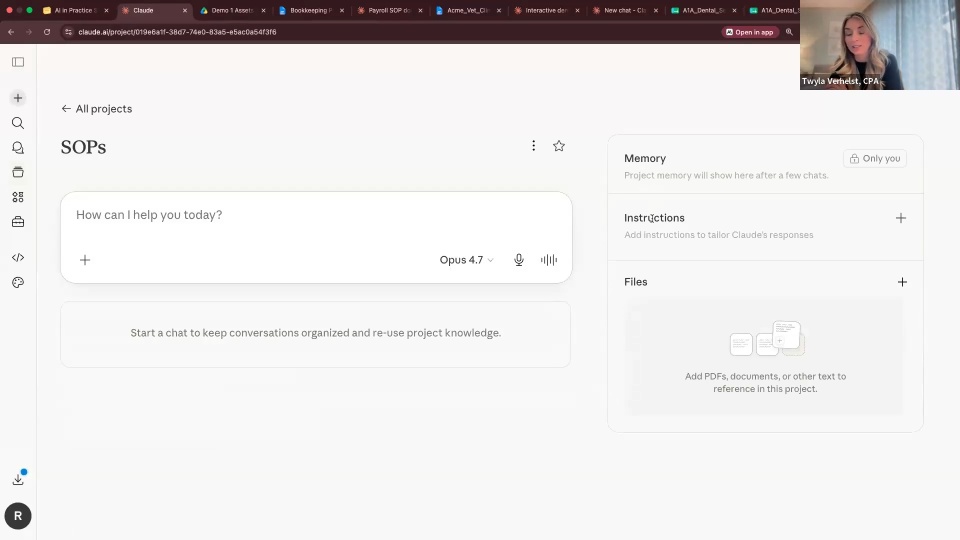
This interface is Claude, one of the many LLMs out there, owned by Anthropic. I’ve got Claude’s Cowork open, which is almost like an agentic version of Claude that lets you perform tasks. I’ve built a skill in Claude — a repeatable set of instructions you can use again and again — and it’s one of the things I’ll give you access to later. That skill analyses meeting transcripts, pulls out insights around potential service opportunities, and then turns those into potential service offerings I can take to clients.
To kick it off, I just type forward slash advisory toolkit and it initiates the session. All it needs initially is one meeting transcript, so I’ll drop one in from my files. Claude now runs through the instructions in the skill, reads the transcript, and tries to identify service opportunities based on the signals shared. Thinking back to the slides — goals, pains, challenges — it’s now pulling those out. It found client goals: adding a sales leader, exploring a capital facility, restructuring under a holding company. It pulled out pain points: cash flow being tight, margins being too far apart, last quarter’s numbers giving them a wobble. It found deferred decisions, and upsell signals like cash flow forecasting, breakeven analysis and R&D tax claims. And emotional cues with specific quotes — “this does feel safe,” “that’s higher than I expected,” “last quarter shook me slightly.” It went through the transcript and pulled out all of that automatically. We didn’t need to remember it or write it down; we just captured the transcript and the prompt did the rest.
23:11A security caveat before you use real client data
Before going further — a really important security caveat. If you’re using something like Claude or ChatGPT to do this with real client transcripts, make sure you’re on a high enough plan to opt out of having your data used to train the model. With all these LLMs there’s a setting, often included on a Teams plan or above, along the lines of “are you happy for your data to be used to fine-tune and train the models?” Any time you’re using anything that includes client data, make sure you’re opted out. If we’re putting this information in, we don’t want it retained and we definitely don’t want it used to train the model. Please keep that in mind if you go and use this with real meeting transcripts.
24:45From signals to a prioritised advisory scorecard
Now what it’s saying is that before we pull out patterns, we want to give it enough input data for a meaningful trend. So I’ll add three more transcripts from other meetings with this same client and run it again. When you get access to this skill, it works the same way — install it and it walks you through step by step.
Across all four meetings, similar themes are surfacing: cash flow anxiety, an intercompany balance between two entities, tax optimisation, and hiring and workforce decisions. That’s the first stage — mining the transcripts and pulling out the potential opportunities and signals.
The next stage turns these into a scorecard we can prioritise. I’ll say “let’s proceed,” and it identifies the potential service opportunities, telling me the exact client quotes so I understand the specific needs. It’s saying the top three are cash flow, intercompany governance and tax optimisation, broken down into themes, with the client’s own language describing each problem. Then it ranks everything into an advisory opportunity scorecard: cash flow forecasting and scenario planning scores fives across the board — the client needs it, we can deliver it, high revenue potential, reach out now. Proactive tax planning has been mentioned a couple of times; we may need the right competencies in-house or a partner to deliver it better, and it’s high value. In about five minutes we’ve run a few transcripts through and generated an actionable, prioritised list we can sense-check.
One thing we didn’t do here is input the existing services we already provide this client. A way to improve this workflow: if you have an existing scope of services, include it with the initial prompt so the model looks for the gaps. If you already offer cash flow forecasting, there’s no point surfacing it again. The skill continues beyond this — it walks through more stages, including packaging an opportunity into an actual service and then drafting email templates and marketing collateral so you can reach out to clients. Because we’re short on time I won’t run all of that now, but I’ll make sure you get the skill so you can run the whole process end to end. I pretty much guarantee you’ll spot at least one or two opportunities from your own client meetings.
29:23Doing it inside Vinyl: revenue opportunities
Everything I’ve shown is possible in Claude or ChatGPT, and I’ll give you all the prompts and skills. But something exciting happened this morning. The product team shipped a feature, and the timing is perfect because it lets me show how this works directly within Vinyl. As of today we’ve released something called revenue opportunities, built directly into Vinyl, that surfaces revenue opportunities from single or multiple meetings across your entire client base — without the risk of copy-pasting transcripts into LLMs and not understanding the security implications.
For those who don’t know, Vinyl is an AI meeting assistant purpose-built for accounting firms. We launched last year and we’re already working with just over 400 accounting firms globally. Xero handpicked us as one of four of their growth apps for 2026 — they pick four apps every year to back and support, and we were one of them. We’ve had incredible feedback on how the platform helps firms capture meeting transcripts, make them accessible to the team, and streamline post-meeting actions. We already have actions built in — drafting client follow-up emails, creating file notes, creating detailed summaries, even generating AML risk assessment reports — and the one we added today is revenue opportunities.
Let me give you a quick demo. I open one of my meetings in Vinyl — the same transcript I just used in Claude. Instead of copy-pasting, I can do this right after the meeting. Maybe I’m the partner and a team member ran the meeting, and I want to sense-check that we’re not missing anything. I open the meeting, click revenue opportunities, and in one click it analyses the meeting and surfaces all the potential revenue opportunities based on the signals shared, then creates a nice PDF document. It found five opportunities: an R&D tax claim, financial modelling and forecasting (the cash flow piece from earlier), entity structuring and tax planning, and some virtual CFO work. For each, it pulls out key client quotes, tells me why it matters, and tells me how to raise it in conversation with the client — almost an exact playbook to take this opportunity into a conversation. It also gives me potential next steps and the total value of the work.
32:26Scaling across many meetings — a weekly ritual
Now think about this across multiple meetings. In the Claude example there was a lot of manually adding transcripts, and I only added four because that’s all I had downloaded. In Vinyl this is much quicker. I click add meetings, search for a specific client — in this case the demo client, Apple Limited — select all the meetings anyone on the team has had with them, and run the same revenue opportunities prompt across all of them at once.
Here’s the example I want you to think through, off the back of that customer who reached out the night before. Imagine you logged into Vinyl once a week, selected all the meetings you and your team had with clients that week, and ran this revenue opportunities prompt. Think about the insights, the signals, the things team members or even you might have missed because you were concentrating on the conversation. That would take a couple of seconds: log in, select the meetings, insert the prompt, hit go, and Vinyl analyses them all at once. I selected five meetings here, but the context window in Vinyl lets you select up to 40 hours of meetings in one go — roughly 60 to 80 meetings depending on length. That’s easily a week’s worth in a lot of firms, and a month’s worth in some.
While that’s loading — although revenue opportunities is one use, you can do the same thing to pull out frequently asked questions, or to analyse client sentiment: “analyse all my meetings over the last month and tell me how clients are feeling — which are unhappy, which are happy, which are singing our praises.” Any of those questions you can answer quickly within the Ask Vinyl interface. There we go — it’s produced a PDF with all the revenue opportunities from those meetings, the exact quotes, why they matter, and how to raise each with the client. Super actionable, super quick, and it means you don’t have to worry about finding these signals yourself.
35:17The mindset shift: from reactive to proactive
Recapping as we get toward the end — there’s a mindset shift that needs to happen. If you’re reactive, you wait for clients to ask for help. And a lot of clients won’t ask, because they don’t know what to ask for. They don’t understand all the services you can provide, because they’re business owners. What it needs is proactivity: telling them the things you can help with, off the back of what they’ve shared with you. You don’t want to sit down and rattle off a list of twenty things that aren’t relevant. The better approach is to have the conversations you’re already having, extract and mine all the signals they’re sharing, and then go to them with a very specific set of services off the back of that conversation. This is all possible once you start capturing all those meeting recordings.
If you scan the QR code on screen it takes you to a landing page; put your email in and we’ll send you the Claude skill, the template pack with all the prompts, and a guide explaining how it all works. And if you wanted to trial Vinyl as the AI notetaker to capture all of this, you don’t even have to worry about Claude or the prompt pack, because you can manage it all directly in Vinyl in one or two clicks after each meeting.