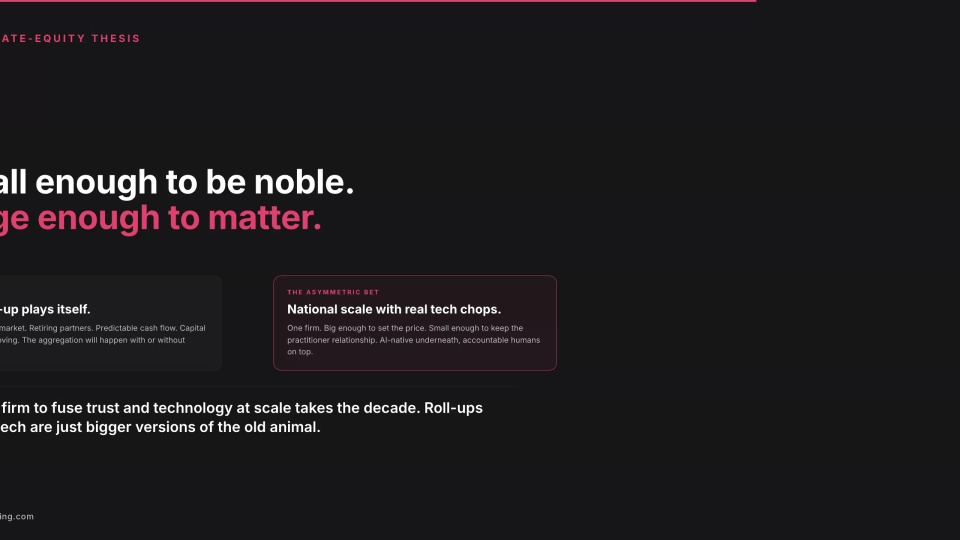
“I want to be leading the pack, not chasing it, so to speak.”
In this fireside chat, Vinyl co-founder Jordan Vickery interviews Martin Brennan, founder of Onside Accounting and Tax — a UK practice of about fifty people specializing in venture-capital-backed tech startups. Brennan recounts introducing a technology strategy in mid-2024, realizing at an industry roundtable that his firm was spending nothing on AI while top-25 firms were investing heavily, and ultimately selling Onside to a US technology company. The deal hedges his technology risk, supplies tech talent his small firm could never hire in house, pays him for what he’s built, and preserves meaningful upside tied to future growth.
The core argument is that “scaling ahead of AI” is a business-model decision, not just a tech-stack one. Brennan is refreshingly contrarian on timing: he argues many small, agile, cloud-native firms — and especially those serving paper-based clients like tradesmen and restaurants — can afford to sit tight and watch, because early AI work is rapidly becoming redundant. The urgency for Onside is specific: its tech-founder clients expect a modern, automated, founder-friendly experience, so falling behind risks losing them to more tech-forward competitors.
Practically, Brennan stresses that AI needs full context across CRM, email, Slack, WhatsApp, file storage and Xero to be powerful, and that siloed point-solution AIs won’t be enough. He warns founders not to neglect their day jobs to tinker with AI, to build a genuinely valuable (not break-even) business so they have options, and to partner with real technology operators rather than trying to lead the build as accountants. He closes on culture and candor: most accountants resist change, employees are anxious about their jobs, and leaders should be hypercritical and honest about how little meaningful AI is actually running in their firms — while giving staff clarity and protecting their best people.
Key lessons
- AI's power depends on full context — connect your CRM, email, Slack, file storage and Xero before expecting agents to do meaningful work.
- Timing is firm-specific: agile cloud-native firms serving tech founders should move now; paper-based client bases can wait years.
- Accountants shouldn't lead the tech build themselves — partner with technology operators who understand infrastructure and scale.
- Don't neglect your day job to tinker with AI; founders should keep selling, networking, and serving clients while specialists build.
- A valuable, profitable business gives you real options — merger, roll-up, or private equity — when you decide how much upside to keep.
- Be honest and hypercritical about your own AI maturity; most firms claiming to use AI have nothing meaningful under the bonnet.
Tools mentioned
Resources & links
- 17:31 “I want to be leading the pack, not chasing it, so to speak.”
- 20:40 “Anybody who thinks it's gonna come and go is naive. I would actually say it's probably bigger than those two things combined.”
- 20:40 “I haven't met a single accountant that is actually doing it. Partnering with the right people is really key.”
- 32:22 “Holding on to something for too long can lead to the value of the asset deteriorating, and that can be a huge regret.”
 , the AI meeting assistant for
accountants.
, the AI meeting assistant for
accountants. Jordan Vickery (co-founder, Vinyl) in conversation with Martin Brennan — Founder, Onside Accounting and Tax
04:06Meet Martin Brennan and Onside Accounting
Jordan: Good morning, afternoon, everybody, depending on where you’re joining us from. My name is Jordan, I’m one of the co-founders at Vinyl, and it gives me great pleasure to host this next session all to do with scaling with AI, with Martin Brennan. Martin, do you mind giving us a quick introduction to yourself?
Martin: Sure. I’m Martin Brennan, founder of Onside Accounting and Tax. We’re an accounting and tax advisory practice that specializes in venture-capital-backed tech startups. We’ve been going nearly five years now — in fact, the company was formed five years ago today. So five years down the road, and we’re a team of about fifty people. That’s me in a nutshell.
Jordan: It’d be great to learn a little more about Onside in terms of the kind of firm, and also what made you start thinking about AI as a new problem rather than a future one to solve.
Martin: I started thinking about AI probably a little earlier than most. In June 2024 I introduced a technology strategy into the firm. I explained to the team that this disruption was coming and that we had to think about how we’d deal with it. Later that year I sat down at an event with the Alternative event company, and most of the top twenty-five firms — senior partners or senior IT people — were in the room. There were a lot of roundtable discussions about approach and how much they were spending on AI, and we were spending nothing. Given that we were starting to compete with the mid-market and taking customers from bigger firms, I was becoming more and more concerned that we might fall behind.
06:29Why the urgency is different for Onside
Martin: Realistically, small firms like ours can’t necessarily hire top tech talent in house. It’s very difficult, and the vast majority of accounting practices in the UK and globally are very small SME practices — I’m sure they have similar problems. But for us the need was more urgent, because all of our customers are incredible tech founders, and they expect their accountant to be using the best tech on the market. They expect them to be modern and forward-thinking, and they get irritated by too much manual work. So I felt it was a bigger problem for us than for other firms. Other firms can probably wait one, two, three, four, five years and watch what other people are doing and learn from that. But for us, the time is now.
I was fortunate to meet a company called Multiplier Holdings — a US technology company with tier-one VC backing. I was weighing up what I wanted for the firm: how could I protect the firm and its staff and my own assets? I never wanted to leave the business — I still don’t. I want to be in the business for another ten or twenty years. I never really wanted to go down the private equity route either. I’ve seen that firsthand, many years ago in the first practice I worked for, and I’ve seen what it does to companies and to the industry. It just wasn’t the right fit for me — although nothing against private equity. It’s a brilliant thing for founders who want to exit, but for me it just wasn’t the right thing.
So Multiplier was the answer to my problems. We struck a deal whereby I sell Onside to them, they give me all of the technology talent we need to hedge against this technology problem that’s coming our way and make sure our clients are well looked after, and I maintain meaningful upside in the future. We’re in the early stages of the partnership, but we’re now doing a lot of the foundational work that will lead to a very different way of working in years to come. This time next year, our jobs will look very, very different.
08:50What the AI strategy looks like in practice
Jordan: You didn’t have an AI strategy at the time, you heard from these much larger firms that did, and since then you’ve brought tech talent on board through your partnership with Multiplier Holdings. Talk us through what your AI strategy looks like now.
Martin: The overall strategy is to elevate staff and client experience. That’s a really important message, because there’s an awful lot of misunderstanding about what AI can do, what it should do, or what it’s expected to do. I often get questions about what it’ll mean for job cuts, for pricing — there’s this assumption that you’re just going to save loads on staff cost, automate everything, and therefore have a really cheap price and service. That’s absolutely not what we’ll do. We want to free up staff to spend more time with customers, build more relationships, and spend more time on oversight rather than admin. And from the staff side, we want to wow them with tools that don’t exist on the market today and make their lives very easy. There’s a lot we can do to make everything more founder-friendly for our customers.
11:07Concrete examples: handovers and client forms
Martin: A couple of examples that benefit staff and clients. On the staff side: if somebody goes on holiday, becomes sick and needs a period of absence, or leaves the company, one of the things that’s always really difficult is handing over the work. You’ve got a CRM with an idea of where each job is up to, then conversations happening on WhatsApp and Slack and email, and those things aren’t necessarily connected. The conversations are often private and not visible to the wider firm, and not integrated at all to the CRM or your file storage like Microsoft SharePoint.
So one of the things we’re dreaming about is: imagine somebody goes off for three or six months, and you use an AI agent to say, “so-and-so is away for a few months. I want to hand over these fifteen clients to these three people, five clients each. Give them a summary of recent conversations, the important deadlines coming up, exactly where each job is up to, and any context that would be useful.” We’ve done some light testing on this, and if you get your CRM, your Slack, your email, your WhatsApp, your file storage, your Xero — all of that properly integrated — the context is there for the AI agent to give you something really meaningful. Whereas today you’re spending an awful lot of time figuring out where things are up to, digging through files and email history, maybe asking two or three staff members. That problem exists in every practice of every size right across the world.
On the client side, a good example is filling out forms. Clients get irritated when, at the end of the year for a personal tax return, you send them a checklist asking them to confirm their address, date of birth, tax position, all of that. I went through this myself recently completing medical forms for an appointment — they sent me six forms and I had to write name, surname, date of birth, address on every single one. It was really irritating as a busy founder. So we’ve got prompts in the system that make sure these things are always up to date, and if we do need information from a client, we want the requests that go to them to be pre-populated to the fullest extent possible, so clients are only filling the gaps.
Then there are the computational aspects of a tax return — they might send a huge Excel file with capital gains transactions, and you want the system to interpret that, check whether it’s right, and almost converse with the client before it comes to you. If they send it for the wrong tax year or the wrong month, you want the system to spot it and send it back. When the system is happy it’s got what it needs, it interprets the results and pushes through to a draft tax return.
15:15Is AI really a “future problem”?
Jordan: In a lot of conversations I’ve been having with firm owners, they’re thinking about AI as a future problem — twelve, twenty-four months from now — and they’re not sure what or why they should be doing something today. Why do you think that framing is dangerous and maybe not helpful?
Martin: To be honest, I don’t think it’s dangerous — I think it’s the opposite. It depends on why you’re thinking it. For a company that can’t afford to hire good tech talent, or doesn’t have a business valuable enough that a private equity or AI roll-up company would be interested in acquiring it, I actually think sitting tight and watching what happens is quite a good tactic. It goes against the framing of the question, but I’ve spoken to accounting practice leaders who’ve been building for the last two years, and the speed at which AI is developing means a lot of that early work has become redundant. So the sit-and-wait approach isn’t such a bad idea.
But there are warning signs. I talked earlier about the need for all aspects of your business to be connected and fully integrated in order to give staff and clients an AI-enabled service. AI needs the full context, and without it, it can’t be that powerful. If you’re not able to integrate your systems properly, are you relying on individual companies and their AI tools working in silo — Xero’s got their AI, Karbon have got their AI — and will they be as powerful siloed in their own spaces? For me, that won’t be good enough, and that’s why we made the moves we did over the last year or two.
17:31Which firms can afford to wait
Jordan: Do you think there are other risks or challenges firms might experience if they delay — say someone wants to bury their head in the sand and wait for the whole thing to blow over?
Martin: It depends on the industries you’re operating in. We’re looking after really talented technology founders who have a certain expectation. But if all your customers are tradesmen, coffee shops, restaurants, then you’ve probably got quite a lot of time, because those industries actually prefer to work on paper. If you ask a tradesman to start invoicing out of a phone app, you’re going to get some challenges. So it really depends on where you look. Resilience to the market is something you should always be thinking about — it’s a big part of your risk strategy. But if you’re not looking after those paper-based industries, you should be thinking more strategically. The last thing you want is to lose good customers to firms who got ahead of you. I don’t want to fall behind our competition — I want to be leading the pack, not chasing it.
Jordan: My takeaway is that there’s a benefit to moving now and moving quick, but it’s very much dependent on your firm and your clients. Working with tech startups is almost pushing you to be more on the front foot.
Martin: Absolutely. If I were one of my customers and thought we weren’t moving with the times, I’d be looking elsewhere for the most tech-friendly accountant there is. So it’s really important that we’re one of the leaders.
19:51Compounding advantage
Jordan: Have you seen examples — in your own firm or through conversations — where acting early creates a compounding advantage that others might struggle to catch up to?
Martin: Probably not in terms of AI and accounting practices, but I do quite a lot of angel investing, and one thing I’ve seen is that companies with several years of data and learning have a serious advantage over new entrants learning the hard way. “Compounding” is a word we use internally nearly all the time. There’s an awful lot of incremental gains happening here, and if we get past this initial foundational piece — getting everything talking to each other, properly integrated — that’s when the compounding really begins. I haven’t seen examples in accounting practices, but I’ve seen those advantages in other industries, especially technology companies.
20:40Myths firms get wrong about AI
Jordan: Moving from firms getting left behind to the perception of AI in general — what are the top two or three things firms are misjudging or misunderstanding about AI right now?
Martin: You touched on number one. Anybody who thinks it’s going to come and go is naive. I think it’ll be as disruptive as paperless accounting was fifteen years ago, and as disruptive as cloud accounting was when the likes of FreeAgent and Xero came along. I’d actually say it’s probably bigger than those two things combined, and ignoring it is not a good strategy.
The second isn’t quite a misjudgment, but there are a lot of people saying they’re using AI. Being really honest about how bloody hard this thing is is a much better approach than pretending. Nearly everybody who tells me they’re using AI — when I ask them to show me the conversation, it normally falls a bit dead at that point. I’m the opposite. A year or two ago I was very honest, saying we’re not set up for this, we need to get ready properly, and we need to speak to experts. I don’t think an accountant who’s been an accountant all their life is the right person to lead the technology build for an accounting practice. You need proper technology people who understand the infrastructure and how to protect against things like technology becoming outdated really fast, which I’ve seen happen in a few firms. You need operators beside you who have experience with scale. It’s really important not to fall into the trap of thinking this is something you can do by yourself. I haven’t met a single accountant who’s actually doing it. Partnering with the right people is really key.
23:00Advice for smaller firms without tech budgets
Jordan: An off-the-script follow-up. You partnered with Multiplier Holdings, so you’ve got investment from a tech point of view. A lot of people listening are smaller firms without the time or budget to spend on tech consultants. What would you recommend? How should they approach overhauling the tech within the firm?
Martin: A couple of things. If you’re a practice manager, managing director, CEO or COO, why would you want to spend tens of hours on this? It’s not what you’re good at or employed to do. You should be in a position of influence and oversight and contributing, but that work should be led by somebody who understands what they’re doing. What you don’t want to do is neglect your day-to-day job. I met one practice owner recently who was struggling to grow the business, and when I asked how they spent their days, they were doing a lot of toying around with AI. They’re clearly very interested in it, which is great, but they hadn’t been to a single networking event or spent any time with clients in the six months they’d been playing around with AI. That’s a common problem. Human beings are drawn to the things they enjoy, not necessarily the things they should be doing. If you’re trying to grow your business, spending a load of time on AI yourself is not a good idea.
The other part of your question — what can smaller firms without budget do? Now more than ever, you need a business that is valuable. I don’t think you can be operating as a break-even business, or with an adjusted EBITDA of zero. A lot of companies don’t pay the founders salaries, so the business looks profitable, but when you factor in two cofounders working day in, day out on minimum wage, there isn’t much profit there. It’s really important to have a business that’s worth something, because if you get to the point where you need to join forces with somebody — maybe a merger with another firm — there’s a lot of movement in private equity, and a lot of opportunity in these new AI roll-ups popping up, similar to Multiplier. Having a valuable business is a very good opportunity.
26:10What “scaling ahead of AI” actually means
Jordan: The title of this session is “scaling ahead of AI.” What does that actually look like in practice? Hiring new team members? Adjusting pricing? Technology? New service mixes?
Martin: It’s about keeping a goal in sight — what is your AI goal? I mentioned we just want to improve staff and customer experience. A lot of other firms don’t look at it like that at all; they see it as an opportunity to drive margins and reduce admin, and that’s fine. There’s a lot of scaremongering on that point, but no doubt some firms will work like that. Start backwards from your goal. We know we’ve got the right partners for the long term — Multiplier have been absolutely incredible. But we also knew there’d be hard work in the early stages, because we’re getting used to one another and there’s a lot of research on their side, observing how we do our jobs. My team are spending more time with Multiplier now than a year ago, so you’ve got to plan around that. Long term we’ll get a lot of gain; short term it’s going to be hard work.
Operationally, we’ve had to structure 2026 a bit differently. We’ve got people with extra capacity to work with the Multiplier team to make sure everything continues to flow. If you’ve got people head-down in client service all day, they’re not going to give your technology partners the support they need to give you the technology you need. So I’ve deliberately overhired for this year, and some of my leadership team have had their responsibilities stripped down to the bare bones to make sure they can work more closely with the Multiplier team and get ready for what will be a huge improvement to all our working lives in future years.
28:27Timing — too early or too late
Jordan: How should firm owners think about timing? When is it too early to move, and how do you know if you’re already moving too late?
Martin: It’s all about the size of the company. If you’re a really small, young company, you’re extremely agile and nimble, and you can probably afford to be more reactive and take your time. If you’re a Big Four firm, it might be five years of work just to get AI-enabled. I speak to people in the Big Four and the top ten regularly, and it’s much harder if you’re a gigantic company with all kinds of complexity in your IT infrastructure. Same in other industries — insurance companies, banks, HMRC — these organizations have very complex IT infrastructure, and it’ll be really hard to truly AI-enable them, so they need lots more time to plan. If you’re a really young, small company with mostly cloud-based tools, honestly, I don’t think you’re in any rush. I’d hold tight and probably see what’s going on around you before making any big decisions.
29:55The three first moves — and the equity question
Jordan: If somebody watching wants to get started tomorrow with their AI strategy, what are the first two to three moves they should make?
Martin: Start with the end goal — what do you want it to look like? Number two is how much do you want to give up? A lot of people were surprised that I gave away the equity in my company — some of it was a swap into the parent company, but a lot of people were surprised I sold the company because of this. A year down the line, a lot of people are thinking the same way, and people ask me about it all the time. For me, if you can get an arrangement whereby you hedge against the technology risk completely, de-risk the problem because you’ve got amazing partners, get paid something for what you’ve built up to now, and maintain upside in the future — that’s an incredible blend if you’re the kind of founder who wants to be in the business for the long term.
That leads to number three: do you want to be in the business long term, or do you actually want to think about whether this is the right time to exit and let the business go into a combination with other businesses, led by somebody else? I speak to a lot of accounting practice owners, and many have reached out to me on the Multiplier deal. I’ve got pretty good connections through to private equity as well, so I help some people on this. The first question I ask is: do you want to be in the business long term, or go off into the sunset? That’s telling. The slight majority is people who just want to cash in and don’t want the challenge of AI for the next five or ten years of their life, and that’s fine.
32:22Timing as a founder’s biggest lever
Martin: If you’re sat on something quite valuable, the last thing you want is to disrupt it. Practice owners I know who’ve done really well and been happy in life generally have taken advantage of timing. There’s always a good time and a bad time to do things, and holding on to something for too long can lead to the value of the asset deteriorating — that can be a huge regret. So it’s a serious consideration: have they got the stomach and the fight for this disruption that’s going to affect the next ten years? If not, maybe it’s a good time to cash in your chips.
Jordan: The really interesting thing coming out of this is that when we talk about technology and AI, it’s not just a technology conversation — it’s almost a full business-model, business-future conversation. The impacts of what you do next go far beyond the tech stack within your firm; they’ll impact the trajectory of the firm over a longer term.
Martin: It’s too common that people hold on to things for too long and then have regrets. It’s probably a minority of leaders that have the real strategic thought process you need to conclude that this is the right thing for you. There’s nothing more heartbreaking than seeing somebody build something up and then seeing it lose its value over time. It’s a serious consideration everybody should have at this moment in time.
33:59The smallest experiment: curiosity
Jordan: Drilling down into practical takeaways — what are some of the smallest experiments or things firm owners could do as soon as this week to start building this muscle?
Martin: Not really an experiment, but one of the values we put in the company recently is curiosity. In the last year, I’ve fallen in love with that as a personal value and as a company value. Leaders in accounting practices feeling a little lost with this should spend lots and lots of time with people they can learn from. I spend an awful lot of time with technology people, with VCs, with high-net-worth angel investors who’ve done things with AI, and I learn all sorts every day. For the first four years of Onside, even though we’re a fully remote, work-from-home business, I went into London every Wednesday for four years straight and did nothing but meet people I could learn from. That served me really well. You have no idea where these conversations go, what you might learn, who they might introduce you to. It’s stuff like that that led me to the people I have around me now. It’s very easy to be head-down on client service, sales, and marketing — that’s normal, we’ve all done it to get where we are — but it’s really important to keep learning and keep abreast of what’s going on, and to have people around you who understand the problem better than you do. I feel incredibly comforted by the Multiplier team, because whatever’s going on in my head — whatever I’m worrying or anxious about — is something they can understand and answer better than I can myself.
36:33The value of community
Jordan: There are a number of community groups out there for accounting firms — one of the sponsors for this summit is the Digital Accountant Club. Groups like that, where you can network with other practitioners and learn what they’re doing from an AI or technology point of view, can help inspire you.
Martin: That’s great, and practical examples are always good. They’re quite hard to find, because not many people are doing it properly or willing to share. There’s nothing wrong with being vulnerable and throwing yourself into a community with a hundred people who are all worried about the same thing. I couldn’t speak more highly of surrounding yourself with people who have the same problem — that’s one route to finding people you can learn from, bouncing things off each other, sharing ideas and problems. All of that leads to good things.
37:58Signals you’re falling behind
Jordan: Are there any signals firm owners should look out for that might tell them they’re not keeping up in the way they should be to protect their business, clients, and team?
Martin: You need a really good understanding of how resilient you are to this disruption, and that starts with your customers and your competition. What kind of customers do you have, and is there an expectation on their side that you’re going to automate everything and reduce fees? Is there an expectation they’ll have to stop using paper, or completely change the tech stack you use because the one you’re on isn’t going to be AI-friendly? Starting with your customers is a really good point — hence the earlier reference to restaurants and paper-based companies that will remain protected against AI for quite some time, in my opinion.
The second is the people. What do you want that to look like? Do you want to be cutting people? Do you want to be automating people’s jobs fully? Culturally, do you have the right people to embrace change? I can say with relative certainty, based on experience, that the majority of accountants are resistant to change. I’ve been part of huge change-management projects where we’ve had to shift thousands of customers from one piece of software to another, remove paper from our business entirely, and we built our own cloud accounting tool many years ago and had to train fifty people on something completely different from the A4 lever-arch file they were using before. It’s tough. You always have people who are hungry for it and people who are not. In our team now we’re piloting some stuff, and we’ve got a group in one team who are really hungry for this, and I love that we’ve got those people in the business. There will be some hard conversations and hard realizations on the staff members’ end.
40:30Be upfront — delaying a problem compounds it
Martin: I had a really nice conversation with a business owner recently who had all of these things in their head — they knew all these problems were coming, but they’d been putting them off for a year. Generally, if you know something is a problem, delaying it is just going to compound it into an even bigger problem. You probably have to be quite upfront with people if you want a strategy that resembles clarity, and that will mean some really hard conversations. Definitely something I’d be thinking about.
41:13Long-term upside and aligned incentives
Jordan: To wrap up, thinking longer term — one of the words you’ve used a couple of times is “upside.” What does long-term upside actually look like for a firm that gets this right over the next three to five years? And for Onside specifically?
Martin: For us, without going into too much detail, I’m not somebody who’d be in this business for ten more years on a standard salary arrangement — that’s just not going to happen. Multiplier, and companies like Multiplier, don’t want founders who aren’t hungry to grow the business and be incentivized for that. The upside is all linked to future growth. If I can continue to grow the business at the rate we have over the last four years, I stand to do quite well from that, and my team stand to do quite well from that. If we let the business stand still and use the sale as a “well, I’m sorted now, so why should I keep working hard” — that’s not going to lead anywhere. Multiplier do their homework on what kind of founder they want to partner with: do they want somebody likely to down tools after they sell, or somebody with an innate drive? As long as the incentives and reward are aligned, founders keep working at the rate they are. I can’t put my finger on why I’m working harder than I’ve ever worked in my entire life, and that’s post-deal. It shows the model and the alignment are absolutely where they need to be. So think carefully if you’re selling to private equity — that arrangement looks very different. It can work, I’ve seen it work, but a lot of it comes down to the founder and where their motivations are.
42:46Final advice: be honest, vulnerable, and curious
Jordan: Martin, this has been a great conversation — very humble and honest as always. Is there anything else you’d share with the listeners before we wrap up?
Martin: I’m always willing to share advice if I can help somebody, so if you’re going through these concerns, do reach out — I’d be very happy to have a chat. I’d say be really honest, be really vulnerable, be really curious. I see too many practice owners telling the world they’re really using AI when, under the bonnet, there’s not really anything meaningful happening — certainly nothing that would stand against the disruption coming in the next five to ten years. So be really honest, almost hypercritical of your own business and strategy, to the point where you’re comfortable you’re doing literally all you could be doing. There’s absolutely no value in pretending or saying you’re doing something that isn’t really happening in the business.
Even recently, we get a lot of job applications from people concerned about their business and their jobs. They don’t know what AI is going to do to their jobs, and they want to be in a business that’s well ahead of the curve. Employees are worried as well. If you have really good, valuable employees, you want to protect them, and giving them clarity at this stage is probably more important than it’s ever been. That’s probably my final thing to say.
Jordan: Perfect. Thank you again, Martin. Appreciate you taking the time to be with us today.