A cross-atlantic perspective on M&A in accounting: key differences between the UK and USA

The accounting industry is undergoing significant transformations, and at the heart of these changes is the evolving role of mergers and acquisitions (M&A). James Gosling and Allan Koltin, both seasoned experts in the field, recently discussed how the M&A landscape differs between the UK and USA, shedding light on the unique drivers, challenges, and future trajectories within each market.
Whether you’re part of a firm exploring growth opportunities or an independent practice navigating an increasingly competitive field, understanding these differences can provide crucial insights.
Here’s what they shared—and what it means for your firm.
1. The Rise of Private Equity: A Catalyst for Change
Over the past few years, private equity (PE) has become a major player in the accounting industry on both sides of the Atlantic. According to Allan, “This party started a long time ago, but the current version of it is vastly different.” PE’s involvement has accelerated the pace of change and opened up new avenues for growth.
UK vs. USA: A Comparative View
In the US, PE’s influence has been expanding since the early 2000s, with firms growing from local and regional practices to massive national entities. For example, the 100th largest CPA firm in 2000 had a revenue of $6.5 million, compared to $50 million today. In the UK, while private equity entered the market later, it has had a similarly transformative effect. Firms that traditionally stayed independent are now exploring PE partnerships to remain competitive.
Key Differences
:
• Scale and Speed: The US has experienced a broader and faster integration of PE, creating larger, more aggressive firms. The UK, while catching up, faces slower adaptation due to its smaller market size and unique regulatory landscape.
• Cultural Shifts: US firms have adapted to a more profit-centric model with less emphasis on traditional firm culture, while UK practices often grapple with balancing external investment and maintaining their core values.
Why This Matters
: While both markets see a push from PE, the US has a deeper, more established presence with larger investment models. The UK’s journey is newer and comes with more caution as firms strive to maintain a balance between growth and tradition.
Before embracing PE, reflect on your firm’s core values and strategic goals. Is immediate growth worth potential cultural shifts? In both markets, this consideration is key to sustainable growth.
How would your firm’s culture withstand the high expectations and rapid changes driven by PE investment?
2. The Perfect Storm: Drivers of M&A in the UK
James highlighted a series of drivers that have made M&A a pressing topic in the UK. “COVID was really the shot off the starter gun,” he noted, explaining that the pandemic not only expedited retirement plans but also led many accountants to reconsider what they wanted from life.
The US Parallel
Allan pointed out that many of the drivers mentioned by James mirror those in the US, but with some nuanced differences. For instance, while succession planning challenges exist in both countries, US firms often have a larger pool of potential successors due to the scale of their practices. However, these successors frequently prefer advisory roles over traditional partner tracks, creating gaps similar to those seen in the UK.
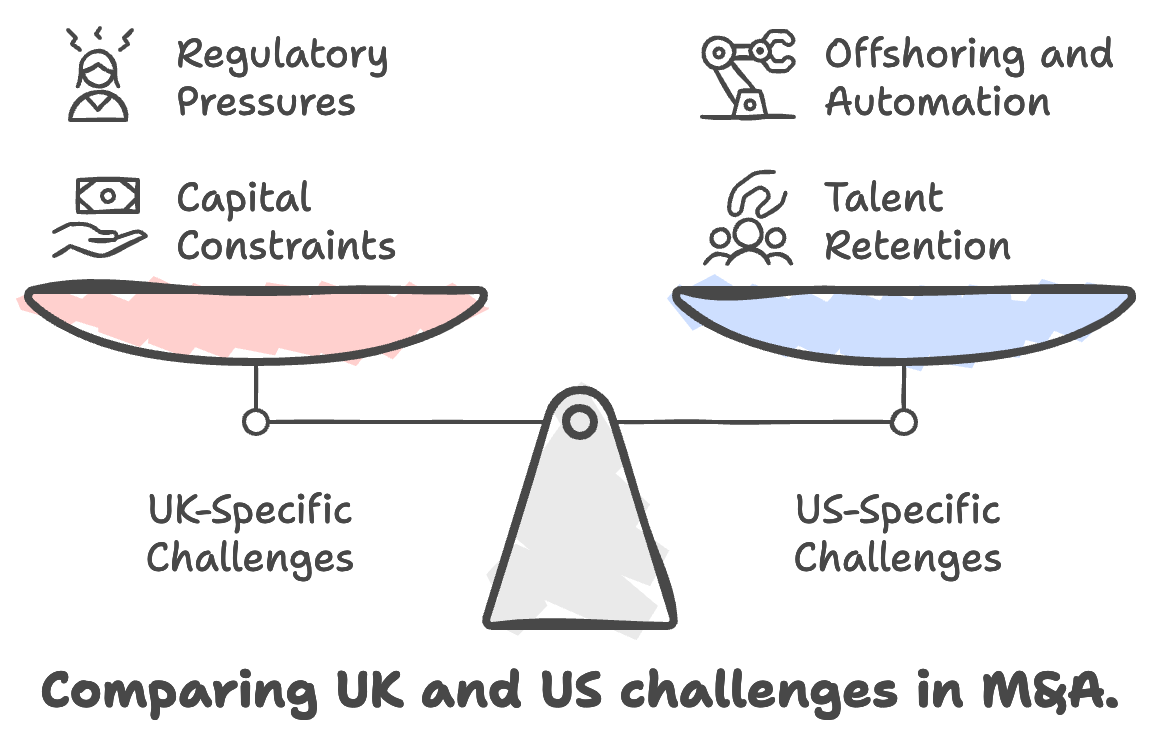
UK-Specific Challenges
:
• Capital Constraints: UK firms face significant difficulties when younger partners try to buy out older equity holders. This financial barrier often leads firms to seek external M&A as a practical solution.
• Regulatory Pressures: Increased compliance and regulation in the UK further push firms toward consolidation or partnerships with PE.
US-Specific Challenges
:
• Talent and Retention: The broader US job market offers diverse opportunities, making it harder for firms to retain top talent, even within larger organisations.
• Offshoring and Automation: US firms have more extensively leveraged offshoring as a cost-cutting and efficiency strategy, impacting how they structure M&A deals.
If you’re a smaller or mid-sized firm, these pressures can be overwhelming. The challenge of succession, especially, is universal. Ask yourself: Can internal talent step up, or is external support the most viable path forward?
Revisit your succession plan. Engage with your team to gauge whether there’s interest and capability to lead or if external M&A should be considered.
Are the next generation of leaders in your firm equipped with the resources and ambition needed to carry your legacy forward?
3. The Talent War and the Tech Transformation
Both James and Allan agreed that talent acquisition and technological advancements are shaping the future of accounting. Allan painted a vivid picture: “What used to take 200 people hours is now done at the flip of a switch. And the kids don’t want to do the mundane work—they want to be advisors”.
Contrasting the Talent Landscapes
In the US, the talent pool is larger, with more graduates entering the profession. However, many young accountants shift from audit and tax to more dynamic advisory roles within their firms or even move out of the industry altogether. The competition for talent is intense, as Allan put it, “It’s not just about finding people—it’s about keeping them engaged”.
In the UK, the talent challenges are similar but intensified by fewer large firms to offer varied internal transitions. This can lead to retention issues, especially as younger professionals look for roles that align more closely with their career aspirations.
The Tech Push and Automation
Technology has become a great equaliser, but the approach differs between the two countries:
• US Strategy: More comprehensive use of offshoring and automation, where outsourcing work at lower rates helps US firms remain competitive.
• UK Strategy: While automation is embraced, financial constraints mean UK firms may move more cautiously. Smaller and mid-sized firms, in particular, look for tech solutions that offer a clear return on investment.
Why This Matters
: The push for automation and tech-driven efficiency means firms must pivot from compliance-focused work to higher-value advisory services. This transition is essential for retaining talent who seek meaningful, strategic roles.
Invest in training that helps younger team members grow into advisory roles. Highlighting pathways for career progression can make your firm more attractive and competitive.
Are you leveraging technology and strategic roles to position your firm as a leader in this rapidly changing environment?
4. Valuations and the Next Generation’s Perspective
Allan shared a revealing insight about how valuations differ internally versus with PE involvement. While internal valuations may yield a payout over a decade, PE offers provide immediate financial gains, often at multiples of 10 to 14.
Comparing Valuations: UK vs. US
• US Market: Large, established US firms often attract higher multiples due to their market presence and size, with some trading at 13 times revenue or more.
• UK Market: While similar trends are appearing, multiples are generally lower for firms with revenues under £5 million. Larger UK firms positioned strategically in the market can command higher valuations.
Generational Dynamics
:
• In the US: Younger partners might prefer waiting to buy out older equity holders at current valuations, then bringing in PE to maximise their returns.
• In the UK: Financial barriers make internal buyouts less feasible, pushing firms to consider M&A or PE involvement.
For younger partners, deciding between independence of ownership and PE’s financial incentives can be tough. Immediate financial benefits versus long-term control is a balancing act.
Engage your younger partners in transparent conversations about their aspirations. Align your firm’s growth strategy with their career goals to create a unified vision.
How does your current valuation strategy align with your partners’ expectations and future plans?
5. The Path Ahead: Predictions and Future Trends
Looking ahead, both James and Allan see continued M&A activity. James described it as a “Russian doll scenario,” where even PE platforms might start acquiring each other. Allan added that IPOs could become a popular exit strategy for larger firms: “I’d wager that we’ll see two or three big firms bypass private equity and go straight to an IPO in the next five years”.
Future Trends: What to Watch For
• US Outlook: Expect PE-backed firms to explore IPOs as a means of scaling even further and attracting public investment.
• UK Outlook: As UK firms consolidate under PE-backed umbrellas, cross-Atlantic partnerships with larger US firms may reshape the European accounting landscape.
Bold Prediction
: By 2026, both the UK and USA may see the emergence of global accounting entities with unprecedented scale and integration, driven by strategic M&A and PE investments.
While the future of accounting continues to evolve, the core principles of thoughtful strategy, cultural alignment, and clear communication remain essential. Whether your firm opts for independence or seeks external investment, being clear on your long-term goals is key.
Reflect on your firm’s current position in the market. Are you prepared for the changes on the horizon?
Sponsored

AccountingEvents - USAM&A
Buying or selling in the next few years?
Join the M&A list: new practices on the board and our reporting on how deals are really done, in The Firm’s newsletter. Free, and one click to leave.


